-

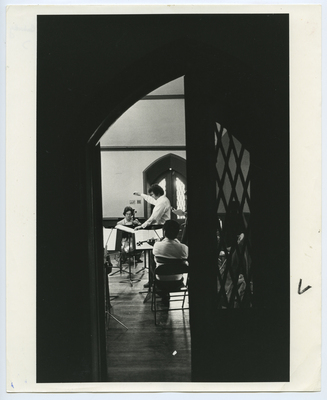
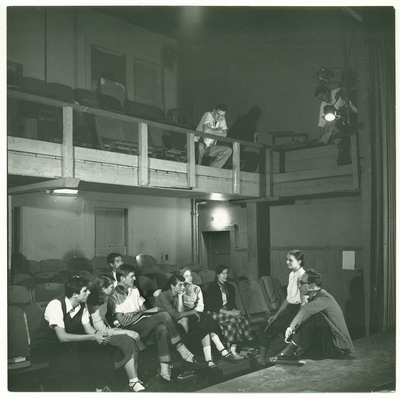
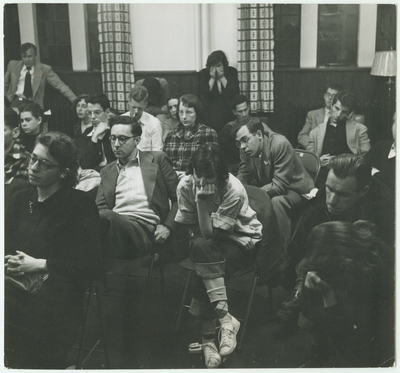
Bard Hall lecture, 1947.
Students listen with rapt attention to a concert or lecture. Identified are Mollie Boring ’47, seated near the window; Fred Segal ’49, at extreme right in second to last row; and Kathryn Carlisle ’47, in plaid shirt near the back.
-
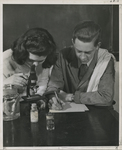
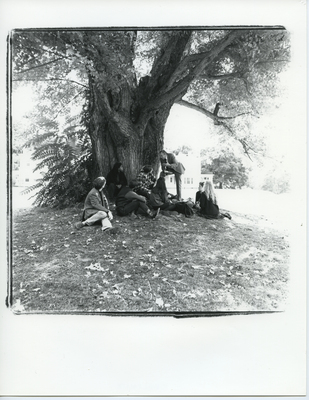
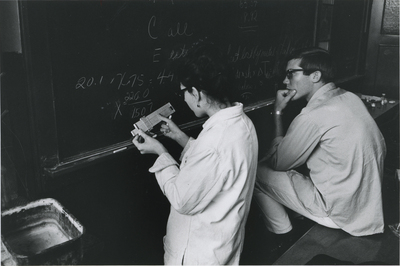
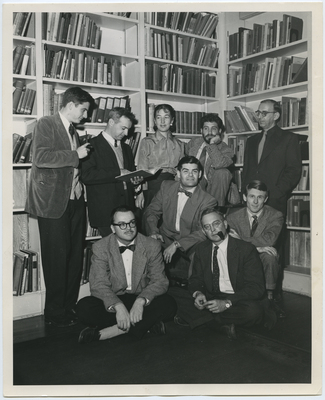
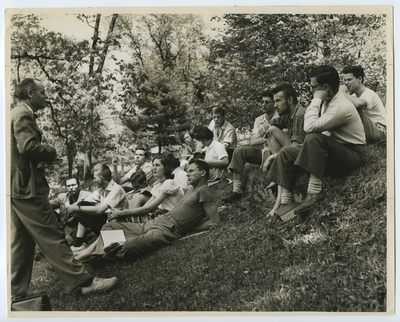
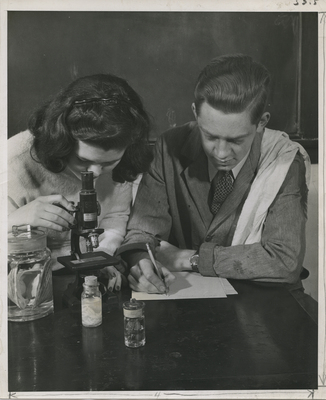
Students, ca. 1947.
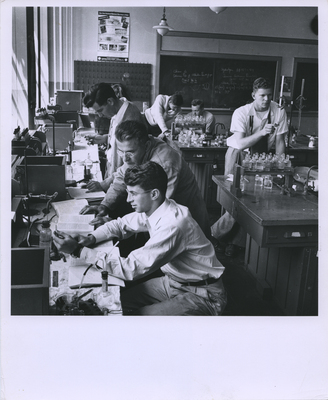
Two biology students work together at a microscope; the man on the right is identified as James Robin McCartney ’47.
-

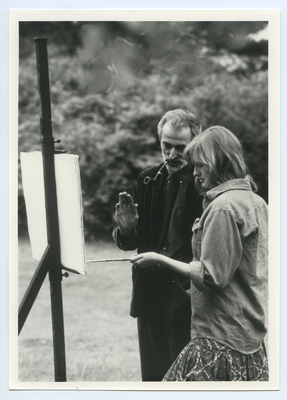
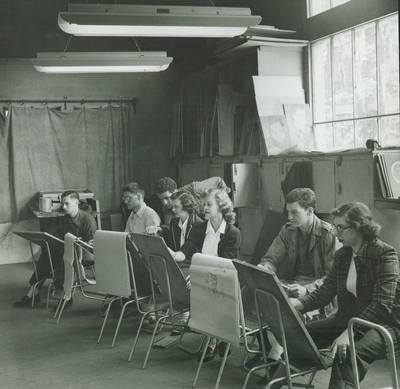
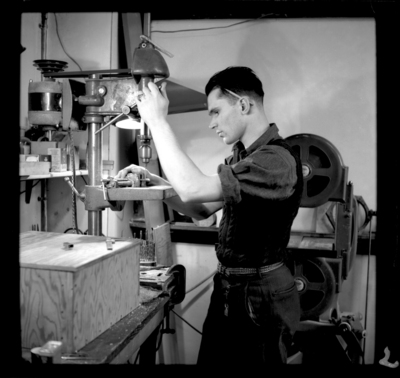
Precisionist painter Professor Stefan Hirsch works on several drafts of his painting, “The Bombing of Nuremberg,” 1947.
Shown here at work in his studio, Stefan Hirsch was one of a number of emigre intellectuals at Bard who enriched the curriculum in the 1930s and 1940s, and provided a sound basis for the 'progressive' label that had come to be associated with a Bard education. Professor Hirsch was a post-impressionist painter, lithographer and beloved teacher who helped to shape the art department, emphasizing the need for students to combine personal creativity with scholarly learning. The completed canvas now hangs in President Botstein’s office. One of many intellectual émigrés at Bard during and after WWII, Stefan Hirsch, along with others (including Felix and Elizabeth Hirsch, Werner and Kate Wolff, Adolph Sturmthal, Emil Hauser, and Heinrich Bluecher), represented a rich infusion of European scholars into Bard’s mid-century teaching community.
-
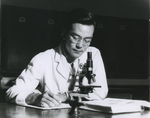
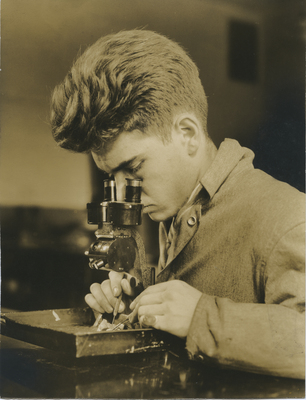
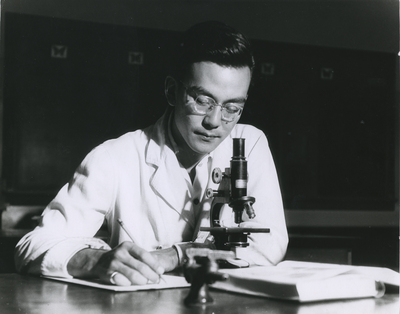
Jin Kinoshita ’44 takes notes beside a microscope, 1944.
Though Kinoshita’s family was held at an internment camp during WWII, he was allowed to attend Bard, where he studied biology. Kinoshita received an honorary doctorate from the College in 1967 after a long and noteworthy career in scientific research.
-

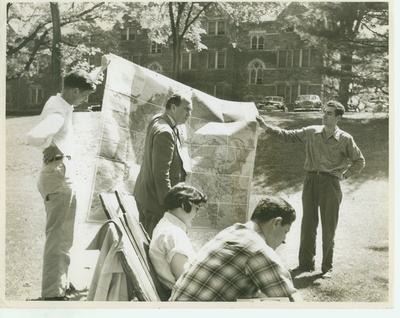
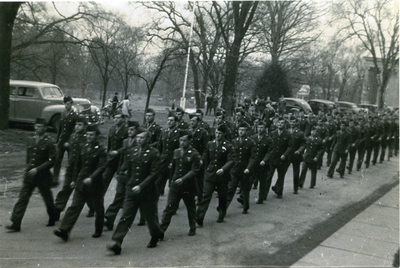
Army recruits on campus, March 1944.
This image captures a drill of the 294- man Army Specialized Training Program stationed at Bard. With most Bard students having enlisted or been drafted into WWII, the College again turned to the government, and sought to house an army training unit on campus to keep its doors open. The soldiers in this elite unit had high linguistic abilities and were taught German by Professor Frauenfelder and French by Dr. Artinian, along with map making, hygiene, etc.